Design literacy · Furniture
Made-to-Order Furniture: Craftsmanship, Fit, and Everyday Function
A piece made for a particular room can do more than fill a gap. When its dimensions, materials, and storage are chosen with daily life in mind, made-to-order furniture turns the awkward corner, crowded routine, or unmet need into a deliberate part of the home.
Most rooms are not blank canvases. They come with a narrow passage beside the dining table, an alcove that seems too shallow for a standard cabinet, or a stretch of wall that must serve as both workspace and circulation route. Furniture catalogs offer many dimensions and styles, but a suitable-looking piece does not always suit the life taking place around it.
That is where made-to-order furniture can be useful. Instead of beginning with a finished object and asking a room to accommodate it, the process starts with the room and the people using it. The result may be a desk sized for a particular work area, a sideboard that brings several storage needs into one footprint, or a material choice that feels right at home and can hold up to regular use.
Customization, though, is not a virtue in itself. A piece that is made to order is not automatically better made, better proportioned, or more useful than a standard item. Its value depends on whether the choices respond to a genuine need. Thoughtful planning can make a room work more smoothly; excessive specification can add complexity without improving everyday life.
Examples from Vermont Furniture Designs show how that distinction can be explored in practical terms. Its handcrafted furniture includes a solid-hardwood writing desk made to order in Vermont and a hardwood sideboard with a defined drawer-and-door arrangement. These pieces offer a useful lens on the questions behind custom furniture: What should be measured? Which materials matter? And when is a tailored solution worth pursuing?
Begin with the room, not the furniture
The most reliable furniture plan starts with use. A desk might need to support a laptop and paperwork, while keeping a bedroom doorway clear. A sideboard might need to store table linens, serving pieces, and everyday household items without overwhelming a dining area. These are not decorative details; they are the brief.
Before comparing finishes or silhouettes, note what the piece must do. List the objects it needs to hold, how often those objects are used, who will use the furniture, and which nearby activities need to remain possible. A beautiful cabinet that blocks a route to the kitchen has failed a basic test. A writing surface that cannot comfortably hold the equipment used every day may look right in a photograph and frustrate its owner in practice.
Measure the room in more than one direction. Record wall length, ceiling height, door swings, window trim, heating elements, outlets, and the location of any fixed architectural features. Then consider the space around the proposed piece. Furniture does not exist in isolation: chairs need room to move, drawers need clearance to open, and people need a comfortable path through the room.
It helps to mark the proposed footprint with painter’s tape or paper on the floor. This simple exercise makes scale easier to judge than a dimension on a screen. For a taller piece, check sightlines and how its height relates to nearby windows, shelves, and lighting. Measurements should be verified before an order is placed, especially where a piece must pass through a hallway, stairwell, or doorway to reach its destination.
A useful design brief can be concise. It might include the furniture’s main purpose, required storage, preferred dimensions, material considerations, finish preferences, and any constraints such as limited access or a sloping floor. The clearer the brief, the easier it is to distinguish essential decisions from optional ones.
What “made to order” can—and cannot—mean
The phrase made to order describes a production arrangement, not a universal promise of unlimited customization. A maker may produce a listed design after an order is placed while offering a defined set of material or finish options. Another maker may permit changes to dimensions or configuration. The scope varies, so it is worth asking what can actually be adjusted before assuming that every feature is negotiable.
Custom furniture is a broader term that can refer to a piece designed around a client’s requirements, but the phrase is often used loosely. Made-to-order furniture may follow an established design and specification; a fully bespoke commission may involve a more individualized design process. In either case, confirm the details in writing: dimensions, wood species, finish, hardware, storage layout, production timing, delivery arrangements, and what happens if the specification needs correction.
There is also a meaningful difference between a tailored piece and an off-the-shelf one. Standard furniture can be a sensible choice when its dimensions and function already fit. It may be easier to compare, available sooner, and more economical. Customization earns its place when it solves a problem that a standard option does not—or when a particular material, construction approach, or storage arrangement is important enough to justify the added planning.
The goal is not to customize everything. It is to make considered choices where those choices have a clear effect on fit, function, durability, or the character of the room.
Craftsmanship is more than a surface
Solid wood often attracts attention for its grain and natural variation, but material choice should be considered alongside construction and intended use. A hardwood desk, for instance, must provide a stable work surface and dependable storage. A sideboard must function as a cabinet as well as an object in the room. Wood selection, joinery, drawer operation, finish, and overall design all contribute to how a piece performs.
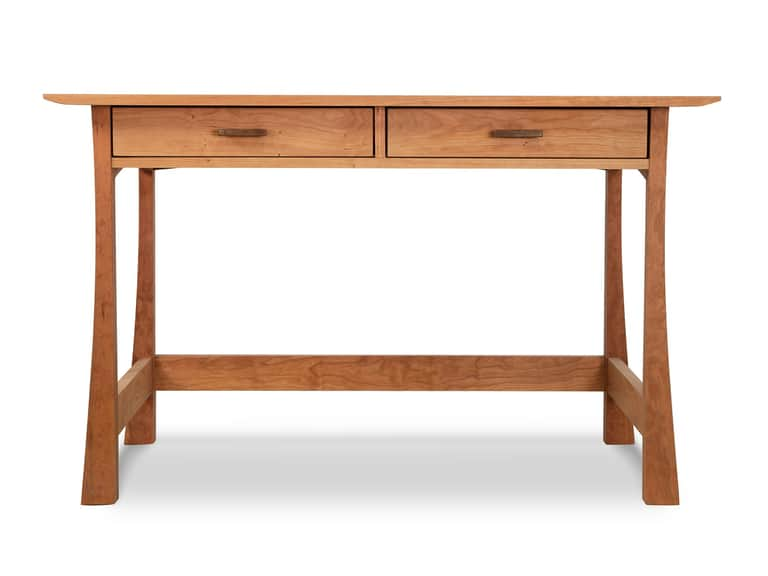
Vermont Furniture Designs’ Contemporary Craftsman Writing Desk is described as handcrafted to order in Vermont and made in solid cherry, maple, or walnut hardwood. It has a 28-inch-deep by 48-inch-wide top, two drawers, and an oil finish. Natural walnut drawer pulls provide a contrasting material detail. Those specifications make the desk’s design legible: a defined work surface, a modest amount of enclosed storage, and a finish intended to protect and enhance the wood’s appearance.
Choosing among wood species is not only a matter of color. Grain, visual movement, and the way a finish presents the wood can influence how the piece sits among other materials. A desk in a compact room may benefit from a quieter visual presence; in another space, pronounced grain can become part of the room’s composition. Whenever possible, evaluate samples in the light of the room where the furniture will live, since daylight and artificial lighting can shift the way a color reads.
Construction deserves the same scrutiny as appearance. Ask how the piece is assembled, how drawers are supported and guided, what the finish requires, and how ordinary wear is expected to show. Not every maker publishes every technical detail, so avoid treating an attractive description as a substitute for clear answers. A well-informed decision rests on the actual specification, not assumptions attached to words such as handcrafted or solid wood.
Storage should reflect real habits
Storage is most effective when it follows the pattern of use. Items reached daily belong somewhere accessible; objects used occasionally can live behind a door or in a less prominent drawer. Before selecting a cabinet or desk, take an inventory of what it will hold. Measure bulky objects and consider how they are handled. A drawer that is too shallow, or a shelf that cannot accommodate a frequently used item, converts storage into a new inconvenience.
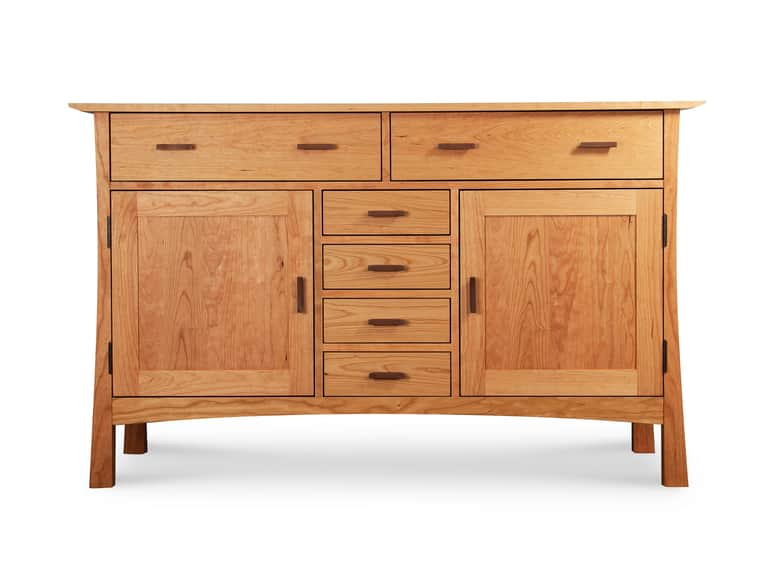
The Contemporary Craftsman Sideboard from Vermont Furniture Designs illustrates one approach to combining storage types. Made from solid hardwood and handcrafted in Vermont, it has six drawers and two doors. Its rounded corners soften the profile, while an oil finish supports the natural appearance of the wood. That configuration may be useful when a room needs a mix of smaller-item storage and concealed space for larger household objects.
The important question is not simply how many drawers a piece has. It is whether the arrangement suits what will go inside. Drawers can make smaller belongings easier to sort and retrieve; cabinet space can accommodate items that do not fit neatly into a shallow compartment. A sideboard used in a dining room may be organized differently from one used in a kitchen or living area, even if the furniture itself is identical.
Think, too, about the surfaces around storage. A sideboard top can provide a place for serving dishes, a lamp, or objects that help connect the furniture to the room. But a surface can become cluttered if it is expected to perform too many roles. The best plan recognizes the piece’s limits and gives it a purpose that can be maintained.
Proportion is the quiet test
Furniture can be beautifully made and still feel wrong in a room. Proportion determines whether an object seems settled or intrusive: its width relative to the wall, its height beside nearby elements, and the amount of clear floor around it. A tailored dimension can help resolve an unusual space, but the chosen size must still support circulation and balance.
For a desk, consider the relationship between top depth and the room’s available clearance. A surface needs enough room for its intended tasks, yet too much depth can make a narrow room feel compressed. The writing desk’s listed 28-inch depth and 48-inch width offer concrete numbers to test against a floor plan and the user’s working habits. They are not a universal ideal; they are a starting point for evaluating whether this footprint is appropriate.
For a sideboard, check its length against the wall and the nearby dining table or seating. Allow space to open doors and drawers without colliding with chairs or interrupting the main route across the room. If the piece will sit below artwork, a mirror, or a window, consider the vertical relationship as well. A room feels coherent when its furnishings relate to one another rather than compete for attention.
These considerations are particularly important in small homes, older buildings, and rooms with unusual proportions. Yet made-to-order furniture is not only for difficult spaces. It can also bring consistency to a larger interior by aligning a useful object with the materials and scale already present.
A practical checklist before ordering
Because made-to-order furniture is planned before it arrives, careful preparation can prevent avoidable disappointment. A short review of the specification is often more valuable than another round of browsing.
- Confirm the purpose. Write down what the furniture needs to support and which functions are secondary.
- Measure the location. Record width, depth, height, obstacles, openings, and the clearance needed for doors, drawers, and movement.
- Check the route into the room. A piece must fit through the home as well as in its final position.
- Specify materials and finish. Confirm the wood or other material, the finish, and any available options rather than relying on a general description.
- Review the configuration. Make sure drawers, shelves, and doors suit the objects and routines they are intended to serve.
- Ask about care. Understand how to clean the finish and what kinds of marks or changes may occur with normal use.
- Clarify the order details. Confirm the agreed specification, expected production and delivery arrangements, and relevant policies before committing.
- Reconsider every upgrade. Keep options that improve fit or function; set aside additions that are attractive but do not answer a real need.
This checklist is not a substitute for a maker’s own instructions. It is a way to make a conversation more precise and to ensure that the eventual piece reflects the room as it is actually used.
The trade-off: time, cost, and certainty
Made-to-order furniture may require more patience than a ready-made purchase. Production takes time, and the buyer needs to make decisions before seeing the completed piece in its home. Depending on the maker and the specification, customization can also affect cost. It is sensible to compare the full value of the choice rather than focus only on the initial price: material, construction, expected use, delivery, and how well the piece fits the room all matter.
Those trade-offs can be worthwhile when a furniture item is expected to serve for years or when a standard size creates a daily frustration. They may be harder to justify for a temporary need, a frequently changing room, or a piece whose particular dimensions and features are not important. A modest, well-chosen ready-made object can be the more thoughtful answer.
Uncertainty is another part of the decision. A natural material may vary from sample to sample, and a finish can look different under different lighting. Detailed specifications, samples where available, and clear communication help set expectations. They cannot eliminate every difference between an imagined object and a finished one, but they can make the decisions behind it more informed.
When customization earns its place
The strongest case for made-to-order furniture is practical. A room has a constraint that matters. A household has a storage need that a generic layout does not meet. A particular work surface must fit an existing routine. The design responds, rather than merely announcing its difference.
Vermont Furniture Designs’ writing desk and sideboard demonstrate two useful scales of that idea. The desk’s specified hardwood options, worktop dimensions, drawers, and oil finish make it possible to assess the relationship between material, form, and task. The sideboard’s six drawers and two doors show how a clear storage configuration can support different kinds of household belongings. Neither example needs an elaborate story to make its point: a piece’s usefulness is found in the details that meet ordinary needs.
That is the quiet promise of customization. It can make furniture feel less like an object inserted into a room and more like a considered answer to the room’s demands. But the answer depends on proportion, construction, and honest priorities. A good brief is not a wish list of features; it is a careful account of how the furniture should work.
A more considered fit
Made-to-order furniture is best understood as a design process, not a status marker. Measure carefully, describe the daily task, examine materials and construction, and ask whether a custom specification solves a problem that a standard option cannot. If it does, the extra attention can yield a piece that fits more naturally into the room and into the rhythms of home life.
If it does not, choosing a simpler option is not a compromise. The measure of good furniture is not how many decisions went into ordering it. It is how well it serves, how comfortably it belongs, and whether its usefulness endures after the novelty has passed.