Bedroom planning
Innerspring Mattresses: Support, Comfort, and Bedroom Fit
A mattress is both a piece of engineering and a piece of room planning. Innerspring construction can shape the way a bed feels, responds, and holds its form; its dimensions, meanwhile, influence circulation, furniture placement, and the character of the bedroom. Understanding both sides makes it easier to choose a mattress that belongs in the room as well as suits the sleeper.
What an innerspring mattress actually does
An innerspring mattress uses metal coils as a principal part of its support system. Those coils compress under weight and spring back when pressure is removed. The result is a responsive feel that can make it easier to change positions, while the layers above the springs—often foam, fiber, or other cushioning—shape the first impression of softness and the way the surface contours to the body.
That distinction matters. The word “innerspring” describes a construction family, not a promise of one particular firmness, comfort level, or performance. Two mattresses with coils may feel strikingly different because their springs, padding, upholstery, and overall design differ. A useful comparison begins by asking what is inside the mattress and how those elements work together, rather than relying on the category name alone.
In everyday terms, the support system helps distribute a sleeper’s weight, while the comfort layers influence pressure and surface feel. Neither function exists in isolation. A supportive core beneath a very thin comfort layer may feel quite different from the same general type of core paired with thicker, softer padding. The mattress also needs an appropriate base beneath it; a bed frame or foundation that does not suit the manufacturer’s specifications can affect how the mattress performs.
Coil design: connected, pocketed, and responsive
Coil systems vary in how springs are shaped, arranged, and joined. In some designs, coils are connected to one another, allowing movement in one area to influence neighboring areas. Other constructions place coils in individual fabric pockets. Pocketed springs can respond more independently, although the feel of any mattress still depends on its complete construction, including padding, spring tension, and the way the unit is assembled.
Spring count is one specification shoppers may encounter, but it is not a complete measure of quality or comfort. Counts can be presented for different mattress sizes, and a higher number by itself does not establish that a mattress will feel better or last longer. Coil design, materials, workmanship, and how well the mattress matches the sleeper and bed base all deserve attention. Specifications are most useful when read as a group.
Some spring systems offer a choice of tension or firmness. That can be helpful when two people share a bed but prefer different levels of resistance. For example, the Vispring Devonshire Mattress uses hand-nested calico pocket springs and is described as available in soft, medium, firm, and extra-firm tensions, with split firmness available in king size. Its stated construction also includes natural wool and viscose fillings, hand-tufting, and a mattress depth of about 8.3 inches, plus doming. These details provide a concrete illustration of how spring tension and comfort materials combine; they are not a substitute for trying a mattress or confirming that its dimensions and base are suitable.
In particular, pocketed construction should not be treated as a guarantee of a specific sleep experience. A mattress with pocket springs may still feel firm, plush, buoyant, or gently cushioned, depending on its complete design. The useful question is not simply whether a mattress has coils, but how the mattress behaves under the people who will use it.
Support and comfort are related, not interchangeable
“Support” and “comfort” are often used as though they mean the same thing. They do not. Support concerns how the mattress holds the body and responds to weight. Comfort describes how the surface feels and whether it suits a person’s preferences. A mattress can feel soft at first contact and still offer a supportive underlying structure; another can feel firm without being a good match for every sleeper.
Firmness itself is subjective. Body shape, sleep position, personal preference, and the mattress’s materials all affect perception. A label such as “medium” can be useful for narrowing options, but it is not a universal measurement shared consistently across every maker. When possible, test the mattress in a way that resembles ordinary use: lie in your usual sleep position, allow time for the surface to settle, and notice whether you feel adequately supported and comfortable.
For couples, the decision involves two sets of preferences. Differences in body weight, preferred position, or sensitivity to movement can make a shared mattress feel unlike the same model used alone. Some designs offer split firmness, while others may suit both sleepers through a middle-ground feel. Discussing expectations before shopping can prevent a common mismatch: one person choosing for a plush first impression while the other is prioritizing a firmer, more stable surface.
When comparing mattresses, take note of practical details as well as first impressions. Ask what support system is used, what materials form the comfort layers, whether the surface is intended to be turned or rotated, and which foundation is recommended. Check the terms of any trial or return policy, too. A brief showroom test can offer useful information, but it cannot perfectly reproduce several nights of use at home.
The bedroom is part of the decision
A mattress is commonly chosen by size first and feel second. In a well-planned room, the two questions are considered together. A larger mattress may offer more sleeping space, but it also occupies more of the floor, affects the scale of the bed frame, and can narrow the routes people use to move around the room. The right size is the one that works for both the sleepers and the space.
Before choosing, measure the room and record the mattress dimensions, not just its familiar size label. Standard names such as full, queen, or king can vary by market, and finished dimensions may differ slightly between models. Include the bed frame in the calculation: its outer footprint may extend beyond the mattress, particularly around a headboard, footboard, or substantial side rails.
Then map the room’s fixed elements. Door swings, wardrobes, radiators, windows, electrical outlets, and the path to an ensuite can all affect placement. A bed that fits neatly on paper may become awkward when a drawer cannot open or a door strikes a corner. Tape the proposed footprint on the floor or use a simple scaled plan to test the arrangement before furniture is moved.
Circulation space is not wasted space. A clear route on each side of the bed makes it easier to get in and out, change linens, and reach bedside storage. The exact clearance that feels comfortable will depend on the room, its occupants, and nearby furniture, but the goal is straightforward: keep the principal paths usable instead of squeezing every available inch into the mattress.
Coordinate mattress size with frame and furnishings
The bed frame is more than a decorative border. It must be compatible with the mattress size and the type of support the mattress requires. Confirm the dimensions of both pieces before ordering, and check whether the mattress needs a particular foundation, slat spacing, or center support. Following the maker’s guidance helps avoid a mismatch that could compromise the mattress or its warranty.
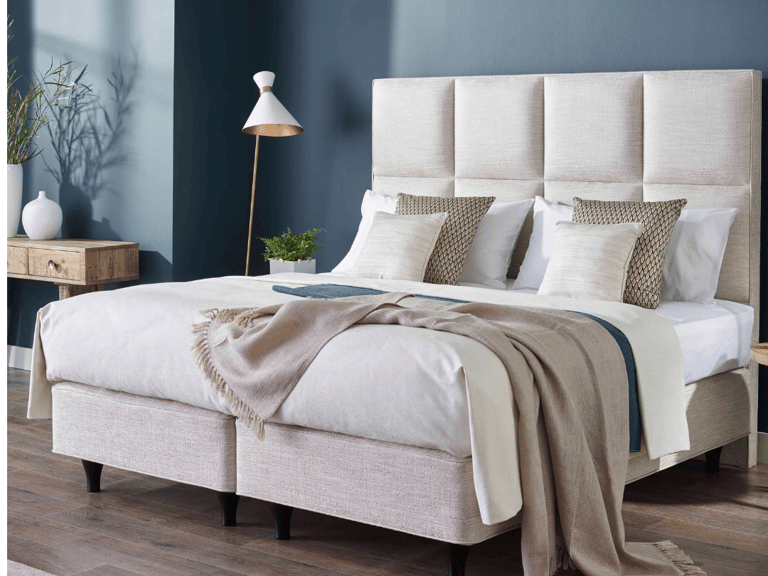
Frame proportions also influence how a bedroom reads. A tall headboard can create a strong focal point, while a low platform may keep sightlines open in a compact room. A bulky frame can make a small bedroom feel crowded even when the mattress itself is an appropriate size. Conversely, an underscaled frame may look unbalanced beneath a large mattress. Consider height, width, visual weight, and the room’s other furnishings as a single composition.
Bedside tables need room to function. Measure their width and depth, and leave enough space to reach drawers, switches, or lamps. A table does not have to match the bed exactly, but its height should make everyday items accessible from the mattress. The same principle applies to a bench at the foot of the bed: it may be useful, but only if it does not obstruct a walking route or a door.
For a bedroom that also serves as a study or dressing space, preserve the room’s secondary functions. A desk, wardrobe, or reading chair should not become an obstacle course around the bed. A simple plan that gives each activity a clear zone can make the room more comfortable than choosing a larger mattress and improvising around it afterward.
Depth, bedding, and the finished bed
Mattress depth affects more than appearance. It determines how fitted sheets sit, how much of a headboard remains visible, and how high the finished bed feels once a foundation and bedding are added. Measure the complete arrangement—from floor to mattress surface—rather than considering mattress thickness alone. A deeper mattress may require appropriately sized sheets, while a low frame paired with a tall mattress can create a different proportion from the one shown in a showroom.
Height also matters for ordinary movement. Consider whether getting into and out of the bed feels natural, especially when the mattress rests on a substantial base. The ideal finished height depends on the frame, mattress, and sleeper; there is no single number that suits every room. If a mattress has a domed or tufted surface, account for the way its shape may affect the apparent height and the fit of bedding.
Linens, mattress protectors, and toppers add their own layers. A topper can alter the surface feel, but it also changes the total depth and may affect fitted-sheet sizing. If a mattress already has a specific comfort profile, decide whether an additional layer is actually needed before buying one. Small changes can have a noticeable effect on how the bed looks and feels.
Materials and care in daily use
Comfort layers may include a range of foams, fibers, and natural materials. Their purpose and feel vary, so look beyond broad labels and ask what is present in the mattress and where. Natural fillings such as wool can contribute to the surface’s character and breathability, while other materials provide different kinds of cushioning. The overall result depends on their thickness, arrangement, and interaction with the spring system.
Care instructions are worth reading before a mattress arrives. Some models are designed to be rotated; others may have a defined top and bottom and should not be flipped. Turning and rotating are not interchangeable instructions. Follow the specific guidance supplied with the mattress, use a suitable protector if appropriate, and keep the support base in good condition. Regular attention to these details can help maintain a tidy, functional sleep setup.
Do not assume that a particular construction is automatically the most durable or sustainable. Ask about materials, manufacturing details, repair or replacement policies, and the expected care routine. If environmental characteristics matter to you, seek clear information about the claims rather than relying on a general description. A thoughtful purchase is one that fits the bedroom and can be maintained in the way the household is prepared to maintain it.
A practical checklist before you choose
Good mattress decisions are made with a tape measure, a few careful questions, and a realistic sense of how the bedroom is used. Before settling on a model, work through the essentials:
- Measure the room. Include doors, built-ins, windows, and the routes people need to use.
- Check the complete footprint. Compare mattress dimensions with the outer measurements of the bed frame.
- Consider sleeping preferences. Think about firmness, sleep position, movement, and whether one or two people will share the bed.
- Understand the construction. Ask about coil type, spring tension, comfort layers, and the mattress’s total depth.
- Confirm the foundation. Make sure the frame or base meets the mattress maker’s requirements.
- Plan around other furniture. Preserve access to wardrobes, drawers, doors, and bedside surfaces.
- Review care and policies. Clarify rotation instructions, delivery access, trial terms, and return conditions.
Delivery deserves its own check. Measure stairways, hallways, landings, and turns, especially in older homes or apartments. A mattress that fits the bedroom can still be difficult to carry through a narrow entrance. Confirm packaging and delivery arrangements in advance, and make sure the route from the door to the bed is clear.
A better fit is both physical and personal
Choosing among innerspring mattresses is not a contest to find the highest spring count or the firmest label. It is a process of matching construction and feel to the sleeper, then matching mattress dimensions to the architecture of the room. The coils matter; so do the layers above them, the base below them, and the pathways around the bed.
That broader view turns a mattress purchase into a more considered bedroom decision. A bed should provide a comfortable, supportive place to rest without taking over the room or making everyday movement difficult. When dimensions, frame proportions, circulation, and personal comfort are weighed together, the result is not merely a mattress that fits. It is a bedroom that works.